What if the number you’re counting to manage your weight or blood sugar is based more on marketing than science?
Many people feel confused when they see terms like “net carbs” on food labels. This is especially true if you’re following a specific eating plan like the keto diet or managing diabetes.
Here’s a fact that might surprise you. The term “net carbs” is not officially defined or regulated by the FDA. It was created by food companies to make products look better for low-carb diets.
This article will clear up the hype. We’ll explain the real difference between total carbohydrates and net carbohydrates. You’ll learn how your body processes different types like fiber and sugar alcohols.
Understanding this distinction is crucial. It directly affects your blood sugar levels, insulin response, and weight goals. We want to empower you with knowledge for your health journey.
Key Takeaways
- The concept of “net carbs” is primarily a marketing term, not a scientific standard.
- Only total carbohydrates, dietary fiber, and sugars are regulated on nutrition labels.
- Different types of carbohydrates impact your blood sugar and body in unique ways.
- Your choice of which metric to track should align with personal health objectives.
- Making informed decisions requires looking beyond packaging claims.
Understanding Carbohydrates: The Basics of What You Eat
Before you can decide what to track, you must understand what you’re actually eating. This part breaks down the fundamental terms you see on every package. It gives you the knowledge to navigate labels with confidence.
What Are Total Carbohydrates?
When you look at a Nutrition Facts label, the number listed for total carbohydrates is your starting point. This figure represents the sum of all the different carbohydrate types in that product.
It includes simple sugars, complex starches, and dietary fiber. This is the only metric on the label that is strictly regulated by the FDA. That means every manufacturer must calculate and report it the same way.
Understanding this number is crucial. It provides a consistent, legally defined benchmark. You can use it to compare different foods and evaluate their overall carbohydrate content.
What Are Net Carbs? A Marketing Term Explained
The term “net carbs” is not an official nutritional definition. It is a marketing concept created by the food industry. You often see it on products aimed at low-carb or ketogenic diet followers.
Companies arrive at this number by taking the total carbohydrates count. They then subtract the dietary fiber and sugar alcohols. The idea is that these components have a minimal impact on blood sugar.
This calculation suggests that the subtracted grams “don’t count” toward your daily intake. For some individuals, this might seem like a helpful shortcut. However, it can be misleading.
The effect of fiber and sugar alcohols on blood sugar isn’t zero for everyone. People with diabetes, in particular, need to be cautious. Their bodies may process these elements differently.
This is why it’s so important to look beyond the front-of-package claim. Always check the full Nutrition Facts panel. You need to see the breakdown of total carbs, fiber, and sugars for yourself.
The different types of carbohydrates—sugars, starches, fiber, and sugar alcohols—all play unique roles. Knowing what makes up the total helps you make better choices. This knowledge sets the stage for understanding how your body handles each type.
By now, you can spot both figures on a label. You also understand the intent behind the net carb claim. This foundation is key for the next step: learning the science of digestion.
The Science Behind How Your Body Handles Carbs

To truly grasp the debate between different carb counts, you need to see what happens inside your digestive tract. The way your system processes various carbohydrates explains their unique effects on your energy and health.
Digestion and Absorption: Simple vs. Complex Carbs
Not all carbohydrates are created equal in your gut. Simple carbohydrates, found in sweets and refined grains, are broken down almost instantly.
This rapid digestion causes a quick flood of glucose into your bloodstream. Your blood sugar levels spike sharply as a result.
In contrast, complex carbohydrates have a more intricate structure. Think of foods like whole grains and legumes.
Your body works harder to break these down. This leads to a slow, steady release of energy. The impact on your blood sugar is much gentler and more sustained.
| Characteristic | Simple Carbohydrates | Complex Carbohydrates |
|---|---|---|
| Digestion Speed | Very Fast | Slow |
| Effect on Blood Sugar | Causes rapid spikes | Provides gradual release |
| Common Food Sources | Table sugar, soda, white bread | Oats, quinoa, beans, vegetables |
| Fiber Content | Typically low or none | Typically higher |
| Satiety & Energy | Short-lived energy, quick hunger return | Long-lasting energy, promotes fullness |
The Unique Roles of Fiber and Sugar Alcohols
Dietary fiber is a special type of carbohydrate. Your body lacks the enzymes to fully digest it.
It moves through your system largely intact. This aids digestion and feeds healthy gut bacteria. Its direct effect on blood glucose is minimal.
Then there are sugar alcohols like xylitol and erythritol. These are hybrid molecules that resemble sugar.
They are only partially absorbed by your body. This means their effect on blood sugar can be variable. Marketing claims often overstate this point.
The unique properties of fiber and sugar alcohols are why they are subtracted in certain calculations. The idea is they don’t contribute usable energy like other carbs.
However, important caveats exist. Some sugar alcohols can still raise blood sugar for some individuals.
Consuming large amounts often leads to gastrointestinal discomfort. Bloating or diarrhea are common side effects.
This knowledge empowers you. You now see why the source of your carbohydrates matters just as much as the quantity.
It’s the essential background for making sense of the practical calculations we’ll explore next.
How to Calculate Net Carbs: A Practical Guide
Ever wondered how a food with 30 grams of carbohydrates can claim to have only 2 that ‘count’? This section gives you the tools to answer that question yourself. You’ll learn the standard formula and discover why doing your own math is often smarter than trusting the package.
The Standard Formula: Subtracting Fiber and Sugar Alcohols
Let’s get hands-on with the most common method for calculating net carbs. The basic idea is to subtract certain components from the total carbohydrates.
These components are believed to have minimal impact on blood sugar. Start by finding the grams total carbohydrates on the nutrition label.
From this number, you subtract all dietary fiber. Then, you subtract specific sugar alcohols. The treatment of these alcohols can vary.
Some, like erythritol and allulose, are typically subtracted completely. Others, like maltitol or sorbitol, are often subtracted at half their weight.
The precise formula many experts use is: Total Carbs – Fiber – Allulose – Erythritol – ½(Other Sugar Alcohols).
Here’s a real-world example to make it clear. Consider a PowerBar “ProteinPlus Carb Select” bar.
| Component | Grams | Notes |
|---|---|---|
| Total Carbohydrates | 30g | The regulated starting point on the label |
| Sugar Alcohols | 27g | Listed in the breakdown under total carbs |
| Dietary Fiber | 1g | Also listed under total carbs |
| Calculation | 30 – 1 – 27 = 2g | The math behind the “impact carbs” claim |
| Marketed “Net Carbs” | 2g | The prominent number on the front of the package |
This table shows how a high-carb food appears low-carb. The formula seems straightforward. However, this is where you need to be cautious.
Why Food Labels Can Be Misleading
The critical fact to remember is this: the term “net carbs” is not regulated by the FDA. The figure on the packaging is a marketing claim, not a verified fact.
Manufacturers may use inconsistent or overly optimistic formulas. They might fully subtract all sugar alcohols, even those known to affect some people.
To be an informed consumer, you must check the full Nutrition Facts panel. Look for the breakdown of total carbs, fiber, and sugars.
Then, scan the ingredient list. Identify sugar alcohols by looking for words ending in “-ol” like sorbitol, maltitol, and xylitol.
This allows you to perform your own accurate counting. For individuals managing diabetes, this step is especially important.
The effect of these substances on blood sugar levels can be unpredictable. Relying on the package claim could lead to unexpected spikes.
Furthermore, consuming large amounts of these foods can cause digestive discomfort. Bloating and diarrhea are common side effects.
This practical guide equips you to verify claims independently. Calculating net values yourself makes you a savvy shopper.
Remember, while calculating net carbs can be a useful tool for certain diets, it’s just one piece of your health puzzle. Understanding its limits prepares you to compare it with tracking total carbohydrates.
Net Carbs vs. Total Carbs: Key Differences and Similarities
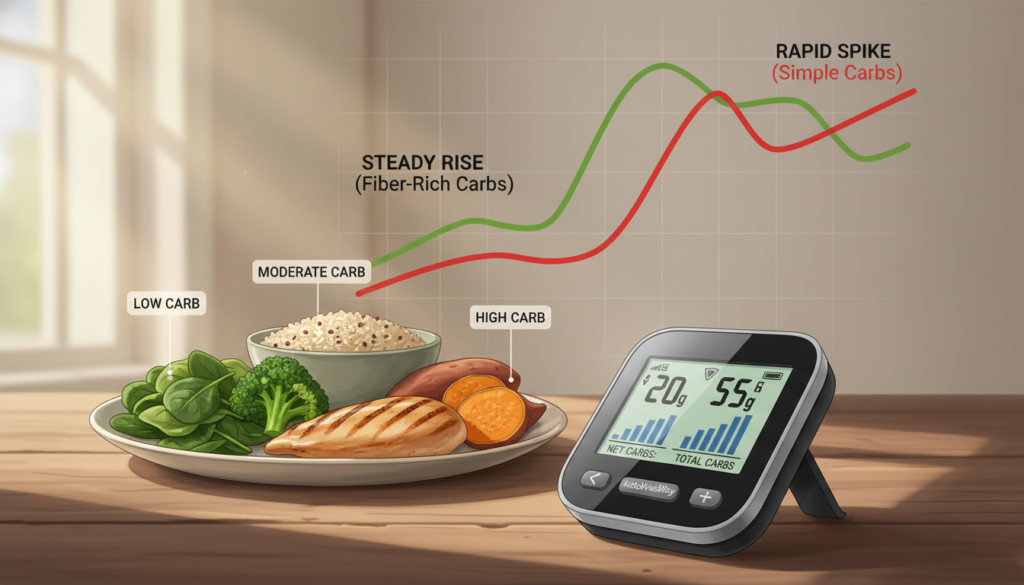
Choosing which carbohydrate number to focus on can feel like picking sides in a nutrition debate. Both metrics offer valuable insights, but they serve different purposes. Understanding their core distinctions helps you apply them correctly to your own health journey.
Impact on Blood Sugar Levels and Insulin Response
Managing your blood sugar is a delicate balancing act. The way you count carbohydrates directly influences this process.
Tracking net carbs is primarily a strategy to estimate glucose impact. It attempts to exclude fiber and certain sugar alcohols believed to have a minimal insulinogenic effect.
This approach can be useful for predicting post-meal sugar levels. However, individual responses vary greatly.
In contrast, monitoring total carbs gives you the complete picture of all carbohydrate intake. This includes every gram that enters your system.
For many people with diabetes, this full-scope view is safer. It prevents unexpected spikes from partially absorbed sugar alcohols.
Insulin response is triggered by the types of carbohydrates you consume. Simple sugars cause a rapid release, while complex starches are slower.
The theory behind calculating net carbs is that subtracted components don’t provoke this response. Yet, science shows it’s not a perfect zero.
Weight Loss, Calories, and the Big Picture
When your goal is to lose weight, a common trap is obsessing over a low net carb count. This narrow focus can make you overlook the total calorie content of your food.
Energy balance is what ultimately determines weight change. You must burn more calories than you consume.
Consider a popular protein bar marketed with only 2 net carbs. It might still contain 260 calories.
Nutritionist Dr. Jackie Berning emphasizes this point:
“A food bar boasting only 2 net carbs might still pack 260 calories, which must be accounted for in your daily energy budget.”
This aligns with the FDA’s core message: “calories count.” Successful weight management hinges on the balance of calories in versus calories out.
For some eating plans, like the keto diet, counting net carbs is a helpful tool. It allows you to stay within strict limits while enjoying high-fiber vegetables.
But it shouldn’t eclipse calorie awareness. The big picture includes nutrition density and food quality.
Here’s a quick comparison to clarify their roles:
- For Blood Sugar Control: Net carbs aim to predict glucose impact; total carbs provide a complete, cautious tally.
- For Weight Management: Net carbs can aid dietary structure; total carbs are less relevant than total calorie intake.
- Similarity: Both are tools to understand your carb intake from different angles.
Neither metric is a magic bullet. Your choice should align with whether your primary goal is blood sugar control or lose weight.
A holistic view is essential for long-term health. Look beyond the numbers on the package.
Consider the calorie density of foods and choose whole, minimally processed foods whenever possible. Your body will thank you for the comprehensive approach.
Which One Should You Track? Tailoring to Your Health Goals
Let’s move from theory to action and match the right tracking strategy to your specific situation. The best metric for you isn’t a universal truth. It depends entirely on your personal health objectives.
Are you aiming to manage your weight or follow a strict eating plan? Or is controlling your glucose the top priority? Your answer determines which figure you should focus on.
For Keto, Low-Carb Diets, and Weight Management
If you’re following a keto diet or similar very low-carb plan, tracking the net calculation is a standard tool. This approach helps you stay within strict limits while enjoying a wider variety of foods.
High-fiber vegetables, for example, can fit into your plan more easily. Most ketogenic plans set a daily maximum of around 50 grams of total carbohydrates.
For general low-carb eating, a practical benchmark is 20 to 75 grams of net carbohydrates per day. This range supports metabolic health and can aid in your efforts to lose weight.
Remember, this is a structural guide, not a calorie-free pass. Energy balance remains the ultimate driver of weight change. Paying attention to your overall carb intake and calorie intake is still essential.
For a deeper dive into structuring your eating plan, learning about your specific keto macros is incredibly helpful.
For Diabetes and Blood Sugar Control
The guidance here is different and more cautious. Major health organizations, including the American Diabetes Association, give clear advice.
They recommend that people with diabetes track total carbohydrates, not the net figure. This is a crucial distinction for safety.
The reasoning is solid. The effect of fiber and sugar alcohols on blood sugar is not zero and can vary from person to person.
Relying on a net calculation could lead to unexpected glucose spikes. For people managing diabetes, predictability is paramount.
Using the full, regulated tally from the nutrition label provides a more reliable and consistent method for managing your condition.
| Primary Goal | Recommended Metric to Track | Key Reasoning | Practical Daily Benchmark |
|---|---|---|---|
| Ketosis & Low-Carb Weight Management | Net Carbohydrates | Allows inclusion of high-fiber foods while maintaining strict carbohydrate limits to support metabolic state. | Keto: Under 50g total carbs. General Low-Carb: 20-75g net carbs. |
| Diabetes & Blood Sugar Management | Total Carbohydrates | Provides a complete, predictable count. The variable impact of fiber and sugar alcohols makes net carbs less reliable for glucose control. | Individualized, based on medical advice. Track all grams of carbohydrate consumed. |
For general weight management without a specific diet protocol, your choice can be more flexible. The most critical factors are your total calorie intake and the quality of your food.
Choosing whole, minimally processed foods over refined options supports your body better than any single calculation.
Ultimately, the smartest step is to consult with a healthcare provider or a registered dietitian. They can help you personalize your approach, especially if you have a condition like diabetes.
There’s no one-size-fits-all answer. With this knowledge, you can now make a confident, informed choice that aligns with your unique health journey.
Conclusion: Making Smart Choices for Your Diet and Health
Your journey toward better health is built on a foundation of knowledge, not just calculations. The real lesson is understanding why you might choose one metric over the other.
Remember, “net carbs” is a useful but unregulated concept. “Total carbohydrates” is the standardized figure on every label. Your best choice depends entirely on your personal health goals.
No matter which number you follow, the quality of your food matters most. Prioritize whole, minimally processed foods like vegetables and fruits. They provide essential fiber and nutrients without the confusing sugar alcohols.
This informed, balanced approach is key to being proactive about your health. You now have the clarity to navigate labels and nourish your body with confidence.