What if the key to unlocking your body’s fat-burning potential isn’t just what you eat, but how you measure it?
Welcome to your personal guide for navigating this exact question. If you’re following a ketogenic diet, intermittent fasting, or a low-carb lifestyle, your system is likely producing these special molecules. Knowing your precise ketone levels, however, is what turns guesswork into a strategy.
You have three main paths to choose from: blood, breath, and urine analysis. Each method offers a different window into your metabolic state.
This article will cut through the confusion. We provide a clear, evidence-based comparison to help you make an informed choice. Think of testing as more than a simple yes or no. It’s a powerful tool for optimizing your health, weight management, and metabolic fitness.
We’ll explore the science behind what ketones are and how each test captures them. Real-world factors like cost, comfort, and accuracy matter, too. While tracking isn’t mandatory for success, it offers valuable feedback and motivation.
By the end, you’ll know exactly which approach fits your goals and daily life. Let’s find your best way to measure progress.
Key Takeaways
- Accurate measurement of ketone levels is crucial for optimizing your nutritional ketosis and fat-burning state.
- Three primary methods exist: blood, breath, and urine testing, each with distinct advantages and limitations.
- Blood testing is considered the gold standard for precision, measuring the exact ketone (BHB) in your bloodstream.
- Breath analysis offers a non-invasive and reusable option, tracking acetone levels from your lungs.
- Urine strips are an affordable and easy starting point, but their accuracy can decrease over time.
- The “best” test depends on your personal goals, budget, and need for specific data.
- Regular monitoring provides actionable feedback, helping you fine-tune your diet and lifestyle for better results.
Introduction: Why Knowing Your Ketone Level Matters
Imagine driving a high-performance car with a dashboard that only shows if the engine is on or off. That’s like following a ketogenic diet without tracking your ketone levels. You know you’re trying to run on fat, but you’re missing the crucial gauges.
Reaching a state of ketosis is the primary goal. But staying in that optimal zone is where the real challenge—and benefit—lies. Many factors can push your levels up or down.
Simply eating keto-friendly foods isn’t a guarantee. Your individual metabolism, portion sizes, sleep quality, and even your workout routine influence your ketone and blood glucose levels.
This is why monitoring is so powerful. It’s the only way to know for sure if you’re in nutritional ketosis, where fat burning and mental clarity are maximized. Think of it as a real-time dashboard for your metabolism.
This feedback lets you identify your personal trigger foods. You can see how many carbs you can tolerate. It shows the effects of intermittent fasting or different exercises.
For many, this data provides crucial motivation. In the early weeks, seeing a measurable result confirms your efforts are working. It turns guesswork into a strategy.
While some people lose weight without ever checking, tracking ketone levels can help troubleshoot plateaus. It helps you optimize results beyond simple weight loss.
It’s important to know that not all measurements are the same. The “best” test depends on what you’re measuring and why. Your body produces three main ketone types.
These are beta-hydroxybutyrate (BHB), acetoacetate (AcAc), and acetone. Different methods track different ones. A blood ketone meter reads BHB. Urine strips react to AcAc. A breath analyzer detects acetone.
Understanding your personal ketone levels empowers you. It puts you in precise control of your health and your diet.
| Factor | Potential Impact on Ketone Levels | Why It Matters |
|---|---|---|
| Carbohydrate Intake | High intake can significantly lower levels. | It’s the primary driver for exiting ketosis. |
| Protein Consumption | Very high amounts may moderate levels for some. | Excess protein can be converted to glucose. |
| Exercise & Activity | Can initially lower, then raise levels over time. | Your muscles use ketones for fuel during adaptation. |
| Hydration Status | Dehydration can artificially concentrate ketone readings. | Especially relevant for urine strip accuracy. |
| Stress & Sleep | Poor sleep or high stress can lower production. | Cortisol can increase blood sugar, affecting ketosis. |
| Metabolic Adaptation | Levels often stabilize or lower as you become fat-adapted. | Your body gets efficient at using ketones, so fewer circulate. |
Using this knowledge, you can move from just following a keto diet to mastering it. The data from a simple test gives you the insight to adjust and thrive.
The Key Reason to Test: It’s More Than Just a “Yes” or “No”
Think of your metabolism as a dimmer switch, not a simple on/off toggle. The real value of checking your ketone levels is understanding where you are on that spectrum.
It moves you from asking “Am I in ketosis?” to “How deep is my metabolic state right now?” This shift is powerful.
Nutritional ketosis is specifically defined by a range of blood ketone levels, typically between 0.5 and 3.0 millimoles per liter (mmol/L). A simple positive test doesn’t tell you if you’re at the low end or the optimal zone.
For those seeking deeper insight, the Glucose Ketone Index (GKI) is a valuable tool. It’s a ratio of your blood glucose to your ketone concentration.
Some research suggests a lower GKI, potentially around 1, may be linked to enhanced cellular cleanup processes. This makes precise measurement crucial for therapeutic goals.
A specific number is infinitely more actionable than a color change. Knowing your exact level lets you connect the dots.
You can correlate a reading of 1.8 mmol/L with that amazing focus you had this afternoon. Or see how a 0.6 mmol/L reading matches your midday hunger.
Your body doesn’t produce a constant stream. Ketone levels naturally rise and fall.
They change based on the time of day, your last meal, your workout, and even your stress. Tracking helps you map these personal patterns.
For weight management, this data is gold. Being at 0.6 mmol/L versus 2.5 mmol/L gives you a clear signal.
It might mean you need to tweak your carbs or extend your fasting window slightly. You move from hoping to strategically adjusting.
Athletes and performance-focused individuals benefit greatly. Precise monitoring helps time fuel intake and tailor training schedules for maximum efficiency.
There’s also a strong psychological component. Seeing tangible results on a ketone meter reinforces your commitment.
It turns abstract diet rules into concrete, personal data. This sense of accomplishment fuels long-term adherence.
This need for quantitative data is why blood analysis is often called the gold standard. It gives you that exact mmol/L number.
Other methods, like breath or urine checks, can still show valuable trends over time. They offer a semi-quantitative view for many people.
The core point is to move from guessing to knowing. This knowledge lets you personalize and optimize your entire ketogenic lifestyle.
| Blood Ketone Level (mmol/L) | Metabolic Interpretation | Common Context & Suggested Action |
|---|---|---|
| Below 0.5 | Not in nutritional ketosis. | Typical for a higher-carb day or early adaptation. Review recent foods and consider reducing net carbs. |
| 0.5 – 1.5 | Light nutritional ketosis. | Common for well-adapted individuals, especially later in the day. Good for general weight loss and wellness. |
| 1.6 – 3.0 | Optimal ketosis range. | Often associated with peak mental clarity, fat burning, and therapeutic benefits. A stable target for many. |
| Above 3.0 | Very high ketosis. | Not necessary for most goals. Can occur during prolonged fasting or extreme restriction. Ensure adequate calorie and electrolyte intake. |
| Glucose Ketone Index (GKI) ~1 | Potentially maximized metabolic efficiency. | A target for some therapeutic protocols, like managing neurological conditions or optimizing fasting benefits. Requires consistent monitoring. |
By focusing on the number, you gain control. You learn how your unique system responds to different choices you make per day.
This turns your keto journey into a finely-tuned experiment, with you as the lead scientist.
Ketones 101: Understanding What You’re Actually Measuring
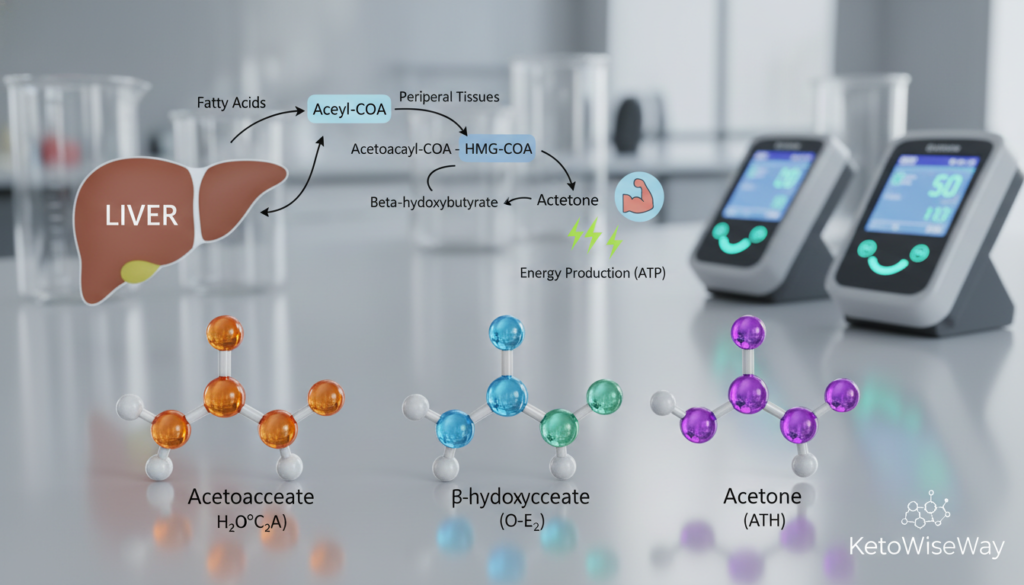
Before you choose a tool to measure your progress, it’s essential to understand what that tool is actually looking for. Your body produces three distinct types of ketone bodies when in a ketogenic state.
Each one tells a different part of your fat-burning story. The methods you use target one specific molecule.
Knowing the difference turns random data into meaningful insight. Let’s meet the three key players.
Beta-Hydroxybutyrate (BHB): The Gold Standard Fuel
Think of Beta-Hydroxybutyrate, or BHB, as the premium fuel in your metabolic tank. It’s the most abundant and stable ketone circulating in your bloodstream.
BHB represents about 70% of the available ketone energy your body uses. It’s the primary fuel source for your brain, heart, and muscles during ketosis.
This is why a blood ketone meter, which measures BHB concentration directly, is considered the gold standard. It gives you a precise read on the active fuel powering your system.
Acetoacetate (AcAc): The Urine Indicator
Acetoacetate (AcAc) is the first ketone your liver manufactures when breaking down fat. Not all AcAc gets converted into the more efficient BHB.
Excess AcAc is excreted by your kidneys into your urine. This happens most noticeably when you’re new to the ketogenic diet or if your body isn’t fully adapted.
Those familiar strips work by reacting to the concentration of AcAc in your urine. The resulting color change gives you a semi-quantitative level.
Acetone: The Breath Byproduct
Acetone is a volatile byproduct created when AcAc breaks down. Because it’s a small molecule, it escapes through your lungs when you exhale.
A breath ketone meter detects acetone in parts per million (ppm). While it’s technically a waste product, its levels in your breath correlate with how much fat your system is oxidizing.
It offers a completely non-invasive window into your metabolic state.
Here’s a simple analogy. BHB is the high-octane gasoline actually powering your car. AcAc is like a bit of unburned fuel that drips out of the exhaust, especially when the engine is cold. Acetone is the distinctive smell of that exhaust in the air.
As you become fat-adapted, your body gets incredibly efficient. It wastes less AcAc and acetone.
This is why urine and breath results can become less reliable over time. Your blood BHB levels, however, remain the truest indicator of your internal fuel supply.
This biochemical foundation is crucial. It helps you interpret your test results correctly and choose the right device for your goals.
All three ketones are normal signs your system is burning fat. They just communicate it in different ways.
Now, let’s examine each testing method that targets these specific molecules.
| Ketone Body | Primary Measurement Method | Role & Characteristic | Key Consideration |
|---|---|---|---|
| Beta-Hydroxybutyrate (BHB) | Blood Ketone Meter | The main circulating fuel used by the brain and body. Stable and abundant. | Considered the most accurate gauge of nutritional ketosis. |
| Acetoacetate (AcAc) | Urine Test Strip | The first ketone produced; excess is excreted by the kidneys. | Readings can be high early on but may fade as you adapt, affecting accuracy. |
| Acetone | Breath Analyzer Device | A gaseous byproduct exhaled from the lungs. Correlates with fat oxidation. | Non-invasive, but sensor calibration and hydration can influence results. |
Deep Dive: Blood Ketone Testing
For those who demand exact data, blood ketone testing stands as the undisputed champion of accuracy. It’s widely regarded as the most reliable method for measuring nutritional ketosis. This approach gives you a precise number, not just a hint.
You get a clear snapshot of your metabolic state. It tells you exactly how much beta-hydroxybutyrate (BHB) is circulating as fuel.
How It Works: The Finger-Prick Method
The process is straightforward. You use a small lancet to prick your fingertip. A tiny drop of blood is collected on a specialized test strip.
You then insert the strip into a handheld meter. The device reads the concentration of BHB in your blood.
Within seconds, it displays your level in millimoles per liter (mmol/L). This gives you a quantitative result you can trust.
The Major Pros: Precision and Real-Time Data
The biggest advantage is unparalleled accuracy. Since it measures BHB directly, it reflects the primary ketone your body uses for energy.
You receive real-time, objective results. There’s no color chart to interpret subjectively.
This precision is essential for calculating advanced metrics like the Glucose Ketone Index.
It provides the trustworthy data needed for serious optimization. If you’re managing a health condition or fine-tuning your keto diet, this clarity is invaluable.
The Cons: Cost and the “Ouch” Factor
The main drawbacks are cost and comfort. The upfront price of the meter is one thing.
The ongoing expense of test strips can add up quickly, especially if you check multiple times per day. The finger-prick itself can be a bit uncomfortable.
For some people, it’s a minor deterrent. It also creates biohazard waste from used lancets and strips.
For consistent results, timing matters. Experts recommend checking at the same time each day.
Ideal moments are in the morning after fasting, or at least three hours after a meal. This gives you a stable baseline away from food digestion.
Popular and reliable blood ketone meter brands include Keto-Mojo. Some combo meters measure both glucose and ketones, offering a full metabolic picture.
It’s crucial to note that for individuals with diabetes, this form of testing is vital. It helps distinguish safe nutritional ketosis from dangerous diabetic ketoacidosis.
While it’s the gold standard, the cost and slight invasiveness mean it’s not for everyone. Yet, for anyone who needs precision, it’s the top choice.
If accuracy is your top priority and a small prick doesn’t bother you, blood analysis is your best bet. It turns guesswork into actionable knowledge.
Deep Dive: Urine Ketone Testing with Strips
For many newcomers to low-carb eating, the most familiar tool is a small bottle of paper strips. This approach represents the most accessible entry point into tracking your metabolic shift.
Urine ketone testing is often the first method people try. It provides that initial, tangible confirmation their efforts are working.
The process is famously simple and completely non-invasive. You don’t need any electronic devices beyond the container and the strip itself.
While incredibly easy to use, understanding its limitations is crucial. This knowledge helps you interpret your results correctly as your body adapts.
How It Works: The Color-Changing Strip
The mechanism is straightforward. You either urinate directly on the reactive end of the test strip or dip it into a collected sample.
After waiting the specified time—usually just 15 to 30 seconds—a chemical reaction occurs. The pad on the strip changes color based on the concentration of acetoacetate (AcAc) present.
You then match this color to a chart on the bottle’s label. This gives you a semi-quantitative estimate, like “trace,” “moderate,” or “large.”
Remember, AcAc is the ketone your liver makes first. Excess amounts are excreted by your kidneys when you’re new to this state.
The reading is an average since your last bathroom break. It’s not a real-time snapshot of your current level.
The Pros: Affordability and Ease for Beginners
The benefits of this method are clear. The cost per test is extremely low, and you can find strips at most pharmacies or online.
There’s no finger prick or special device required. This makes it a comfortable choice for anyone hesitant about blood testing.
For beginners, seeing that first positive result is a powerful motivator. It confirms your diet is triggering the right metabolic processes.
These strips also serve a vital medical purpose. They were originally designed to help individuals with diabetes monitor for a dangerous condition called ketoacidosis.
For your first few weeks on a ketogenic plan, they offer perfect reassurance. They answer the basic “am I there yet?” question effectively.
The Cons: Declining Accuracy and Hydration Issues
The major drawback is that accuracy fades over time. As you become fat-adapted, your system gets efficient.
Your body wastes fewer ketones and excretes less AcAc. Your urine test may show trace or no ketones, even when you’re deeply in ketosis.
Your hydration levels dramatically affect the reading. Dilute urine can show a false low, while concentrated urine might exaggerate your levels.
The color interpretation is subjective. Different lighting or eyesight can change how you read the chart.
Furthermore, the strips themselves are sensitive. Exposure to air and humidity degrades them quickly.
Most bottles are only good for about 30 days after opening. This can lead to wasted money and unreliable data.
A dark purple color early on can be exciting. However, it often signals your body is still inefficient and excreting fuel it should be using.
For long-term adherents, urine strips lose utility for monitoring nutritional ketosis. They become a poor tool for precise dietary adjustments.
They can still serve for occasional spot-checks. For those on a very tight budget just starting out, they provide a basic signal.
If you want a non-invasive method that works better over the long term, breath analysis is a strong option to consider next.
Deep Dive: Breath Ketone Testing

Consider a tool that turns your exhaled breath into a digital readout of fat burning. This is the promise of modern breath analysis. It sits as a high-tech, non-invasive middle ground between the precision of blood draws and the simplicity of urine strips.
You get quantitative data without a single drop of blood. This approach measures a direct byproduct of your metabolic process.
It’s ideal for those who want more insight than a color change but dislike the prick. Let’s explore how this innovative method works.
How It Works: Measuring Your “Fat Breath”
The process is straightforward and quick. You blow into a small, handheld device that contains a sensitive sensor.
Most models use a metal oxide sensor. It detects the concentration of acetone in your exhaled air.
Acetone is a gaseous ketone body. It’s produced when acetoacetate breaks down during fat metabolism.
Your reading appears as a number on the screen. It’s measured in parts per million (ppm).
This number reflects how much fat your system is actively oxidizing. Think of it as a snapshot of your metabolic exhaust.
Unlike blood BHB, which muscles rapidly consume, acetone levels in your breath can be more stable throughout the day. This offers a different view of your metabolic state.
The Pros: Non-Invasive and Reusable
The advantages of this testing method are compelling. First, it’s completely painless and requires no skin puncture.
After the initial investment in the meter, there are no ongoing costs for consumables like strips or lancets. This makes frequent checks economical.
You can use it multiple times per day without any discomfort. It’s quick, convenient, and fits easily into your routine.
As researcher Dr. Dominic D’Agostino has noted, breath acetone is excellent for individuals focused on fat loss and for those who fast regularly.
The results correlate directly with fat breakdown. This makes it a powerful tool for weight management phases.
For many people, the sheer convenience encourages consistent tracking. You get useful data without the hassle.
The Cons: Sensor Sensitivity and Calibration
This technology does have some important limitations. The accuracy of the sensor can be influenced by many external factors.
Recent consumption of alcohol, certain foods like garlic, mouthwash, toothpaste, or smoking can interfere. Even the temperature of your breath can affect the reading.
Metal oxide sensors can drift over time. They require periodic calibration against a known standard to maintain precision.
The upfront cost for a reliable, clinically-validated device is higher. An example is the FDA-approved Readout Health Biosense.
While the test gives a quantitative number, it measures a different ketone than the primary fuel (BHB). The correlation to blood BHB levels isn’t always perfect.
For reliable results, you must follow a consistent pre-test protocol. Experts advise waiting at least 15 minutes after eating or drinking.
Ensuring your meter is properly calibrated is also crucial for trustworthy data.
Modern breath devices are becoming more accurate. They offer a fantastic balance of convenience and actionable insight.
This method is not the absolute gold standard for precision. Yet, it provides a strong middle path.
Breath analysis is ideal for those who dislike blood draws, test frequently, and are willing to invest in a reusable tool. It turns your simple exhale into a window on your metabolic health.
Blood vs. Breath vs. Urine: The Direct Comparison
Choosing the right tool often comes down to a simple trade-off between three critical factors: accuracy, cost, and convenience. You now understand how each method works individually. Let’s put them side by side to see how they stack up.
This head-to-head analysis cuts through the noise. We’ll compare the hard facts across key metrics.
The table below gives you a clear, at-a-glance summary. It highlights the core strengths and compromises of each approach.
| Metric | Blood Testing | Breath Testing | Urine Testing |
|---|---|---|---|
| Accuracy & Reliability | Gold standard. Directly measures BHB concentration in your blood. | Good correlation. Measures acetone from fat oxidation. Can be influenced by external factors. | Least reliable long-term. Measures excreted waste (AcAc), not active fuel. Accuracy drops with adaptation. |
| Cost Over Time | Moderate upfront for meter. High ongoing cost for test strips and lancets. | Higher upfront for the device. Minimal to no ongoing costs after purchase. | Very low upfront and per-strip cost. Strips expire after opening, leading to potential waste. |
| Convenience & Comfort | Requires supplies and a finger prick. Some find it invasive. Must manage biohazard waste. | Quick, painless, and portable. May require a consistent pre-test protocol (waiting after eating/drinking). | Simple but messy. Requires bathroom access and subjective color interpretation. No device needed. |
| Best For | Data-driven individuals, diabetics, athletes, those troubleshooting plateaus, or anyone needing precise feedback. | Those who check multiple times per day, dislike blood draws, focus on fat loss, and want a reusable tool. | Complete beginners, those on an extreme budget, or diabetics screening for ketoacidosis as originally intended. |
Accuracy and Reliability: Which Method Tells the Truth?
When it comes to truth in data, not all tests are created equal. Your need for precision should guide this choice.
Blood analysis is the undisputed champion. It measures beta-hydroxybutyrate (BHB) directly from your bloodstream.
This gives you a real-time snapshot of the primary fuel powering your body. For confirming nutritional ketosis or calculating the Glucose Ketone Index, it’s essential.
Breath testing offers a strong correlation with fat burning. The acetone level in your breath reflects metabolic activity.
However, sensor readings can be swayed by recent meals, alcohol, or oral hygiene products. It’s a reliable trend indicator but not a perfect BHB proxy.
Urine strips are the least dependable for long-term nutritional tracking. They react to acetoacetate, a ketone your body excretes as waste.
As you become fat-adapted, you excrete less. Your strip may show a faint color even with optimal blood levels. This makes them poor for fine-tuning your diet.
Cost Over Time: Upfront Price vs. Ongoing Expenses
Your budget plays a huge role. The economics differ dramatically between methods.
A blood ketone meter might cost a moderate amount upfront. The real expense is the ongoing need for test strips.
If you check your levels daily, this can become a significant yearly cost. Lancets add a minor recurring fee.
Breath analyzers require a larger initial investment for the device. Once you own it, however, your cost per test drops to nearly zero.
This makes frequent monitoring very economical. It’s a classic case of paying more now to save later.
Urine testing is the clear winner for lowest entry cost. A bottle of strips is very affordable.
Remember, these strips degrade after about 30 days. An opened bottle that expires represents wasted money.
For infrequent spot-checks, it’s cheap. For daily data, the value diminishes quickly.
Convenience and Comfort: Fitting Testing Into Your Life
Will you actually use it? The user experience determines long-term adherence.
Blood checks require carrying a meter, strips, and lancets. The finger prick is a minor discomfort some people dislike.
It’s a quick process but generates biohazard waste. You also need to wash your hands beforehand for clean results.
A breath device is typically pocket-sized and painless. You just blow into it.
For consistent results, establish a simple routine: wait 15 minutes after eating or drinking before you test.
This small protocol ensures your reading isn’t skewed. It’s a minor trade-off for a needle-free way.
Urine tests are simple but messy. You need access to a bathroom and a moment of privacy.
Interpreting the color chart can be subjective under different lighting. It’s not the most discreet or precise point of your day.
Best For: Matching the Method to Your Goal
The “best” tool is the one that aligns with your personal objectives. Let’s match profiles to methods.
Choose a blood ketone meter if you’re data-driven, managing diabetes, an athlete optimizing performance, or hitting a plateau. It provides the precise feedback needed for serious adjustments.
A breath analyzer suits those who check often, dislike blood, and prioritize fat loss. Its reusability and comfort make it ideal for daily tracking without ongoing costs.
Urine strips are perfect for week one of your keto journey. They offer that initial “yes, it’s working” confirmation on a tight budget.
Many people find success using a combination. Start with urine strips for the first two weeks to confirm entry into ketosis.
Then, switch to a blood or breath device for long-term, quantitative insights. This phased approach is cost-effective and logical.
Consider your real-world scenario. If you’re a biohacker using prolonged fasting to maximize cellular cleanup, a blood meter for GKI is worth the investment.
If you’re a busy parent just wanting to confirm you’re on track while combining keto with intermittent fasting, a breath meter fits a hectic life better.
No single method is perfect. Your choice is a personal balance of accuracy, cost, and convenience.
This comparison arms you with the facts. You can now select the tool that turns measurement into meaningful progress.
With this clarity, the next step is to apply it directly to your situation. Let’s determine how to make your final choice.
How to Choose the Right Ketone Test for You
Your optimal path to monitoring isn’t dictated by specs alone, but by your unique priorities and lifestyle. This is a practical decision, not a theoretical one.
Let’s turn all that comparison data into a simple action plan. You’ll match the method to your real-world needs.
The right choice balances what you want to know with what you’re willing to do. It also fits your budget for the long haul.
Consider Your Primary Goal
Your main objective is the biggest filter for your choice. Different tools serve different purposes best.
If fat loss is your focus, a breath analyzer might be ideal. Its reading of acetone directly correlates with fat oxidation.
Seeing that number can be highly motivating. It gives you a clear signal of your body’s burning state.
For managing a medical condition like epilepsy under a doctor’s care, follow their guidance. Clinicians often prefer urine strips for children due to their non-invasive nature.
For general health monitoring and diet optimization, blood analysis is typically best. Its precision helps you fine-tune carbs and other foods.
Performance athletes and biohackers also benefit from this gold-standard data. It’s crucial for optimizing metabolic flexibility and timing fuel.
If you’re a beginner simply wanting confirmation, urine strips are a fine, affordable starting point. They answer the basic “am I in ketosis?” question.
Be Honest About Your Budget and Comfort
Let’s talk numbers and nerves. The true cost isn’t just the price tag on the box.
Calculate the annual expense. Testing three times per day with blood strips can cost hundreds over a year.
A one-time purchase of a breath device might seem high upfront. Yet, it becomes very economical with frequent use.
Now, assess your comfort. Are you squeamish about a finger prick? If the thought deters you from checking, it’s not the right method.
The “hassle factor” matters, too. Carrying a meter, strips, and lancets is less convenient than a single pocket-sized device.
Honesty here prevents wasted money and ensures you’ll actually use your chosen tool consistently.
Your long-term success depends on a method you’ll stick with. Choose the one that feels sustainable for your daily routine.
When to Use a Combination of Methods
You don’t have to pick just one forever. A hybrid approach can be smart and cost-effective.
Many people start with urine strips for the first week or two. This cheaply confirms ketone production.
Next, invest in a blood ketone meter for a month. Use it to learn your personal responses to different meals.
Establish your baseline blood ketone levels. See how exercise and sleep affect your readings.
After this learning phase, switch to a breath meter for daily, painless tracking. Use your blood device for occasional spot-checks to ensure calibration.
Another powerful combo uses a Continuous Glucose Monitor (CGM). It shows dietary adherence through stable glucose levels.
Pair a CGM with periodic ketone checks for a complete metabolic picture. This is advanced but highly informative.
How often should you check? It’s unnecessary to test multiple times a day forever.
Consider testing daily for the first week. Then, move to once a week to ensure you’re maintaining ketosis.
Test more frequently when making dietary changes or breaking a plateau. The goal is to learn, then potentially test less.
Remember, tracking is a tool, not an obsession. Some find great value in the data; others find it stressful.
Choose what supports your journey. Your choice can also evolve as your goals and circumstances change.
For your final selection, read reviews and choose reputable brands. Keto-Mojo is a trusted name for blood tests.
Biosense is well-regarded for breath analysis. Ensure you understand how to use your chosen device correctly for reliable results.
| Your Primary Goal | Recommended Method(s) | Key Reasoning & Tips |
|---|---|---|
| Weight Loss / Fat Burning | Breath Analyzer | Directly measures acetone from fat oxidation. Non-invasive and reusable, ideal for daily motivation without ongoing costs. |
| Medical Management (e.g., Epilepsy, Diabetes) | Follow Clinical Guidance (Often Urine for Pediatrics, Blood for Precision) | Safety and protocol are paramount. Urine strips are non-invasive for kids; blood gives precise data for managing insulin resistance. |
| Diet Optimization & General Health | Blood Ketone Meter | Provides the precise data needed to fine-tune carbohydrate intake, interpret the Glucose Ketone Index, and troubleshoot plateaus. |
| Performance & Metabolic Biohacking | Blood Ketone Meter (Possibly + CGM) | Gold-standard accuracy is required for timing nutrition, measuring metabolic flexibility, and achieving specific therapeutic ketosis levels. |
| Beginner Confirmation & Learning | Urine Strips (transitioning to Blood or Breath) | Ultra-low cost for initial proof of concept. Use for 1-2 weeks, then invest in a quantitative device for long-term insight. |
| Convenience & Frequent Daily Tracking | Breath Analyzer | No consumables, no pain, quick results. Perfect for those who want to check often without hassle or recurring expense. |
With this personalized framework, you’re ready to select a tool that empowers rather than complicates your ketogenic journey. The best test is the one you’ll use to learn, adjust, and succeed.
Conclusion: Finding Your Personal Best in Ketone Testing
Ultimately, the perfect ketone monitor aligns with your lifestyle, not just a lab standard. Your ideal choice balances precision, cost, and daily convenience.
Blood analysis gives exact data. Breath devices offer painless tracking tied to fat loss. Urine strips are a simple, affordable start. All confirm your body is producing these molecules, but they measure different things.
Remember, many achieve their ketogenic diet goals without any tools. Sticking to your plan works. Yet, monitoring can accelerate learning and help break plateaus.
If you crave the truth, choose blood. For ease and reusability, pick breath. Want the cheapest entry? Try strips. Your choice isn’t locked in—switch as your needs evolve.
You now have the knowledge to select a supportive tool. Trust yourself. Use the data as a friendly guide, not a strict rule. Whether shedding pounds or boosting brainpower, understanding your ketone levels is a powerful step toward better health. Here’s to finding your personal best!